We flag clinical decline days before it happens.
We connect via API to the electronic health record and monitor hospitalized patients' vital signs and lab results in real time — flagging risk of death and extended stay well in advance. The physician stays in control; we give the team time.
The root cause is simple to name and costly when ignored
Hospitals live with extended stays and growing risk of infection, ICU transfer, and death. In most cases, the cause isn't a lack of data — it's the difficulty of catching clinical decline in time to act. That creates a hard cycle for patients, staff, and administrators.
Cost of extended stays
The longer a patient stays admitted, the higher the cost — and under Brazil's public health system (SUS), that bill is usually absorbed by the hospital itself.
Risk that compounds over time
Extended hospital stays significantly raise the risk of hospital-acquired infection, ICU transfer, and death.
Gaps in early detection
Care teams genuinely struggle to catch early signs of clinical decline amid the pace of day-to-day care.
Communication breakdowns
Delays in communication between teams slow down diagnosis and treatment — exactly when time matters most.
We turn data into decisions — we don't diagnose. We buy time.
Evidence shows patients display signs of early deterioration long before becoming unstable. Deep Medica analyzes scattered clinical data and turns it into a wider intervention window — to reduce risk, cut costs, recover bed-days, and support proactive decisions.
Continuous monitoring
We analyze complex relationships between vital signs and lab results in real time, the moment they're released in the health record.
Prediction
We identify, early, cases at risk of death or extended hospital stay.
Precise alerts
Structured, urgency-stratified alerts for clinical deterioration — averaging 2.31 alerts/day per hospital, with no alert fatigue.
Expanded intervention window
We deliver days of lead time — not hours — for the team to act. Human-in-the-loop: the physician always assesses and decides.
of lead time on risk alerts — well beyond what's typically achieved today, where alerting usually happens in a matter of hours.
is the average number of alerts per 170-bed hospital. No alert fatigue — the team is only notified when it truly matters.
we flag extended-stay risk this early — a risk most solutions on the market simply don't address.
We connect via API to the health record already in place. No system swap, no construction, no infrastructure investment.
Results from a retrospective study of 13,266 SUS patients
We followed the hospital stay of 13,266 patients across public (SUS) hospitals over 3 years, excluding outliers (stays over 60 days) and ICU patients.
R$ 18.7 million in additional cost identified, over 3 years, in admissions flagged for risk of clinical worsening alone.
Scenario: Extended Stay
Admission
Risk alert
Target discharge
Average
Goal: cut the average length of stay of flagged cases by at least 8 days.
Scenario: Risk of Death
Admission
Risk alert
Death
(average)
Expanded intervention window: 12 days — 86% of deaths were flagged within it.
From bedside to management dashboard
One ecosystem covers the entire journey: data capture, real-time analysis, clinical alerting, and management indicators.
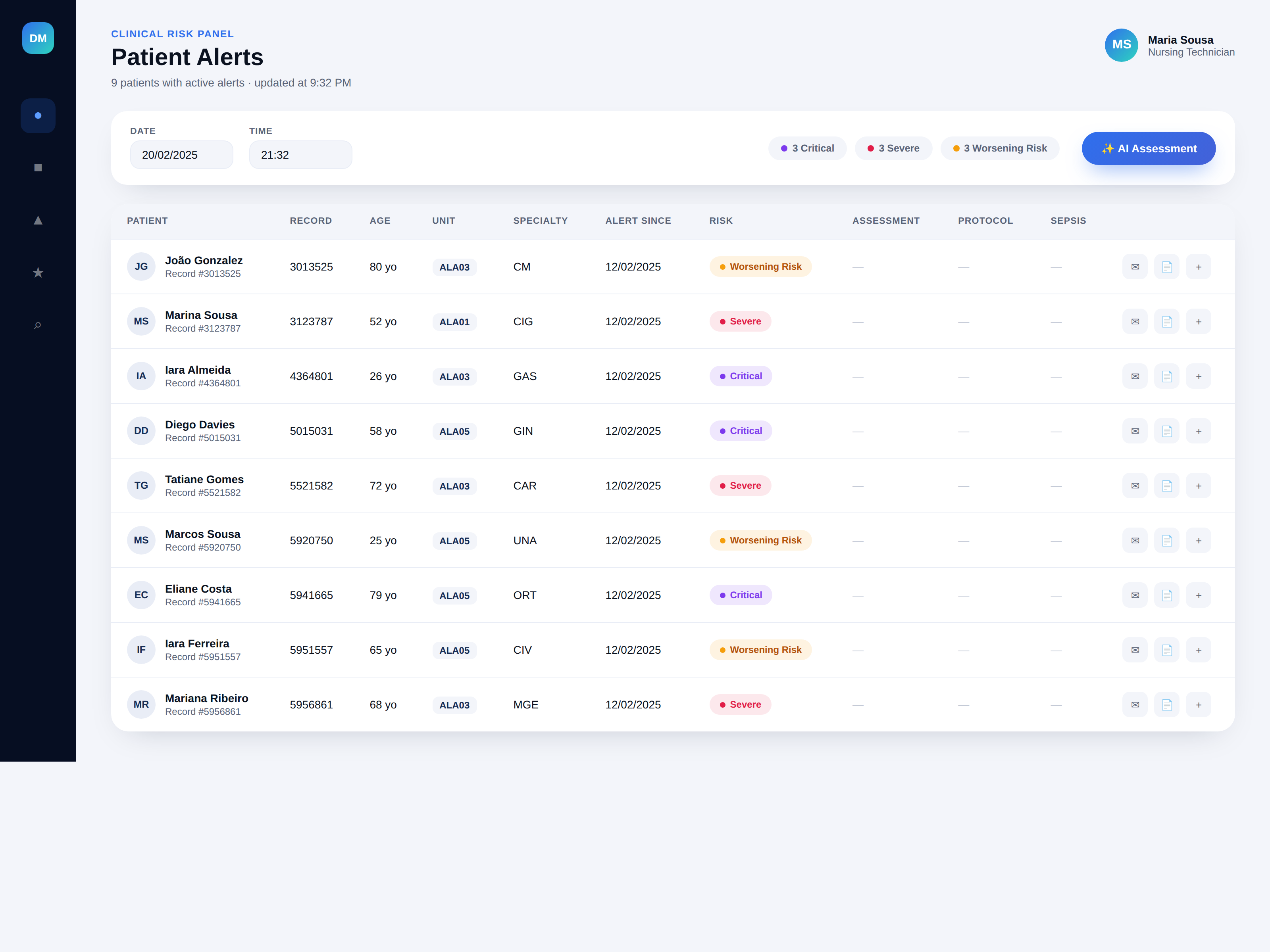
Clinical Risk Panel
The care team sees, in one place, which patients are at risk of clinical deterioration, classified into 3 levels: critical, severe, and worsening risk.
- Breakdown of altered or critical biomarkers per patient
- Physician assessment logged, with date and time history
- Alert dismissal always requires a justification — the workflow itself generates the model's audit trail
- Immediate push notifications for critical cases
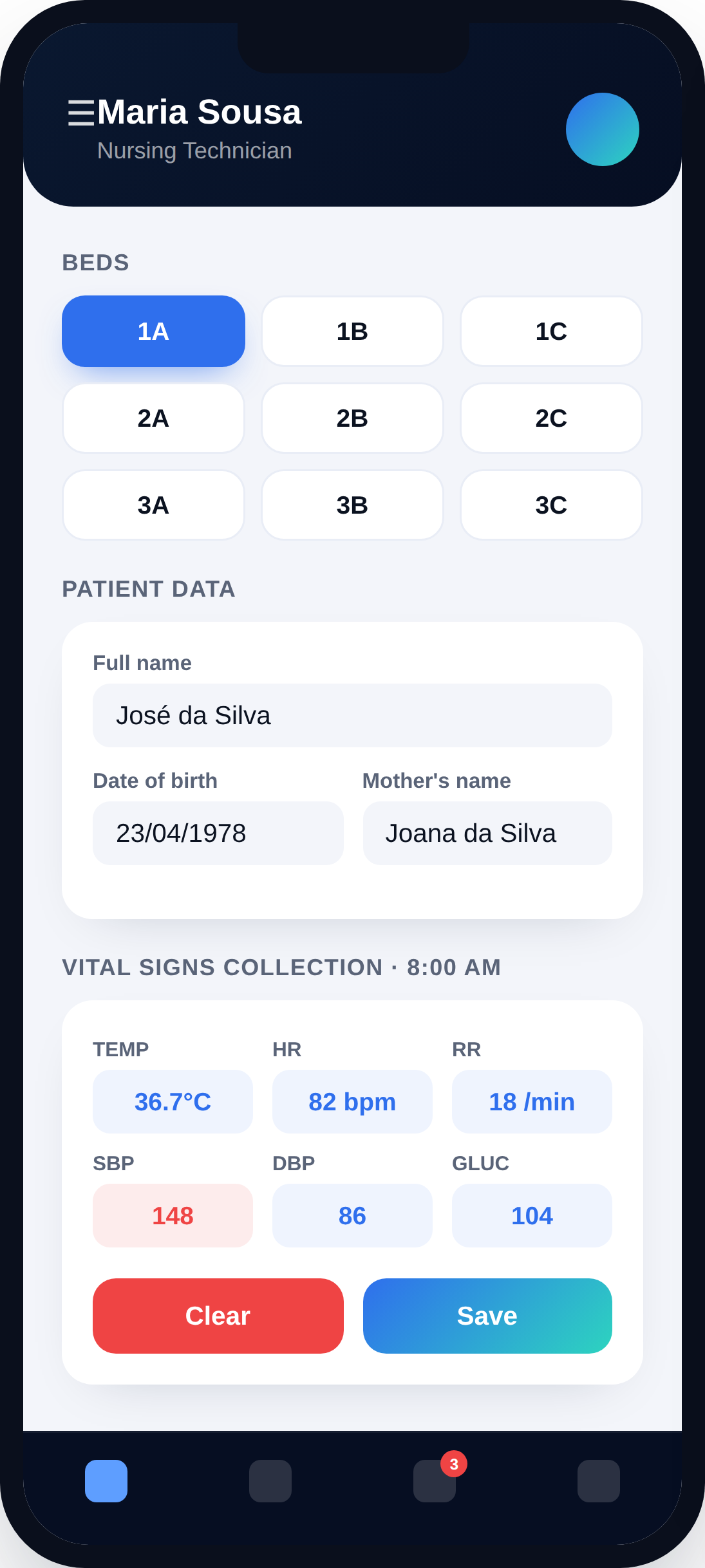
Bedside Recording App
For hospitals without a structured electronic health record, a mobile app lets nursing staff record vital signs and scales right at the bedside — bringing Deep Medica to smaller public hospitals too, where the problem tends to be more severe.
- Vital signs recording (temperature, blood pressure, heart rate, respiratory rate, glucose, saturation)
- Nursing scales (level of consciousness, fall risk, pain, pressure injury, and more)
- Immediate visual alert when a value falls outside the normal range
Electronic health record connectors
API integration with the leading systems in the Brazilian market — no system swap, no construction, no CAPEX.
PDF lab result reading
For hospitals without a structured record, lab results delivered as PDFs are read and biomarkers are automatically linked to the patient.
Care team dashboard
Indicators such as unassessed alerts, intervention window, alert density, and completeness of nursing records.
Management dashboard
Bed-days avoided, estimated savings, average length of stay for flagged cases, and bed turnover — all in one management panel.
You pay for the monitored bed. The return shows up in month one.
B2B2G SaaS with recurring revenue of R$ 5 per monitored bed per day — just 0.8% of the daily cost of a SUS-admitted patient. Only actively monitored beds are billed.
170-bed hospital
Regulatory treated as part of the product, not paperwork
SaMD Class II
Classified and compliant with ANVISA's RDC 657/2022: documented analytical and clinical validation, technical dossier, and risk management.
LGPD-compliant architecture
Patient data is anonymized and encrypted throughout the entire solution architecture.
Human-in-the-loop
We don't diagnose or prescribe treatment — we buy time. The physician always assesses and decides.
Specialist team
Over 12 years of experience in hospital operations, led by an innovation lead, data scientists, ML/software engineers, and an infectious disease physician guiding clinical direction.
Purpose
"Our purpose is to offer a real path to savings and better quality of care, with technology capable of predicting before it happens — so the care team can fulfill its mission, and together we achieve the best outcomes."
DEEP MEDICA
Let's talk about your hospital?
Tell us a bit about your institution and we'll show you how Deep Medica can anticipate your patients' clinical decline.